MUSIC LISTENING AS A STRESS-REDUCTION TOOL FOR OVERWEIGHT INDIVIDUALS: EVIDENCE FROM A RANDOMIZED TRIAL
AUDIÇÃO MUSICAL COMO FERRAMENTA DE REDUÇÃO DO ESTRESSE EM INDIVÍDUOS COM SOBREPESO: EVIDÊNCIAS DE UM ENSAIO CLÍNICO RANDOMIZADO
Isabela
Peres Carvalho[1]
Juliana
Beaudette Drummond[2]
Antônio
Ribeiro-Oliveira Júnior[3]
Frederico
Gonçalves Pedrosa[4]
ABSTRACT
This randomized controlled trial evaluated the effects of a single music listening session on stress reduction in overweight individuals (BMI > 24.9 kg/m2). Participants were allocated to an experimental group (music listening, n = 28) or a control group (podcast listening, n = 26). Stress was assessed through salivary cortisol, subjective scales (VAS), and qualitative topic modeling. Data were analyzed using Linear Mixed-Effects Models (LMM) and post-hoc Wilcoxon tests with Bonferroni correction. The experimental group exhibited a highly significant reduction in cortisol (padj < 0.001) with a large effect size (r = 0.59), while the control group’s reduction did not reach statistical significance after adjustment (padj = 0.07, r = 0.37). Responder analysis showed a 92.9% success rate for music versus 80.8% for podcasts (Odds Ratio = 3.03). Subjective and qualitative data revealed a broader spectrum of relaxation and sensory immersion in the experimental group. Music listening is a superior, predictable, and low-cost tool for neuroendocrine stabilization in overweight individuals, outperforming purely narrative stimuli.
Keywords: Music listening. Stress reduction. Overweight. Salivary cortisol. Mixed-effects models.
RESUMO
Este ensaio clínico randomizado avaliou os efeitos de uma única sessão de audição musical na redução do estresse em indivíduos com sobrepeso (IMC > 24,9 kg/m2). O grupo experimental (n = 28) foi submetido à intervenção musical e o grupo controle à escuta de podcasts (n = 26). O estresse foi avaliado por cortisol salivar, escalas subjetivas (EVA) e modelagem de tópicos qualitativa. Os dados foram analisados por Modelos Mistos de Efeitos Lineares (LMM) e testes de Wilcoxon com correção de Bonferroni. O grupo experimental apresentou redução altamente significativa no cortisol (padj < 0,001) com grande tamanho de efeito (r = 0,59), enquanto a redução no grupo controle não atingiu significância após o ajuste (padj = 0,07, r = 0,37). A análise de respondedores revelou taxa de sucesso de 92,9% para a música contra 80,8% para o podcast (Odds Ratio = 3,03). Dados subjetivos e qualitativos indicaram maior amplitude de relaxamento e imersão sensorial no grupo experimental. A audição musical é uma ferramenta superior, previsível e de baixo custo para estabilização neuroendócrina em indivíduos com sobrepeso, superando estímulos puramente narrativos.
Palavras-chave: Audição musical. Redução do estresse. Sobrepeso. Cortisol salivar. Modelos mistos.
INTRODUCTION
Overweight and obesity represent a global public health crisis, characterized by a complex interplay between metabolic dysfunction and chronic stress (Lizama et al., 2020; World Health Organization, 2023; World Health Organization & Unicef, 2026). This causal connection is mediated by a sophisticated neuroendocrine system, where chronic stress triggers the activation of hypothalamic reward pathways and elevates cortisol secretion. Such alterations not only predispose individuals to hyperphagia and emotional eating (Czepczor-Bernat et al., 2021; Dallman, 2010) but also create a deleterious feedback loop that exacerbates weight gain and complicates nutritional treatment. Consequently, evidence-based stress management has become a critical adjunctive target in obesity clinical practice (Kyrou et al., 2006; Ovbiosa-Akinbosoye, 2011).
In this landscape, music listening is a potent, non-invasive psychoneuro-physiological intervention (Adiasto et al., 2022). The therapeutic potential of music lies in its ability to modulate the autonomic nervous system and the hypothalamic-pituitary-adrenal (HPA) axis through rhythmic and structural properties that can synchronize physiological parameters such as heart rate and breathing (Lee et al., 2016; Thaut, 2003). Furthermore, music acts as a non-caloric rewarding stimulus, potentially modulating the same dopaminergic reward pathways that, when disrupted by stress, drive hyperphagia and emotional eating (Dallman, 2010). While individual musical preference influences emotional engagement, evidence suggests that the inherent relaxing properties of specific musical genres – such as classical or meditative music – can induce physiological stabilization regardless of personal taste, making it a scalable tool for clinical settings (Calamassi et al., 2022; Raglio et al., 2020).
The present study is situated within the field of Psychoneuroendocrinology (PNE), an integrative framework that examines the complex interplay between psychological processes, the nervous system, and the endocrine response. By utilizing PNE as a theoretical lens, we aim to understand how music – as a psychobiological stimulus – can modulate the HPA axis in individuals whose metabolic and hormonal profiles are already compromised by overweight.
To capture the complexity of the stress response, a multi-dimensional assessment is required (Dorsey et al., 2022). Salivary cortisol remains the gold-standard biological marker for monitoring HPA axis fluctuations due to its non-invasive nature and high correlation with unbound plasma cortisol levels (Pastore & Francisco-Maffezzolli, 2018; Thoma et al., 2013). However, biological markers must be complemented by psychometric tools, such as the Visual Analogue Scale (VAS), and qualitative linguistic analysis to interpret the subjective experience of relaxation and mental state (Linnemann et al., 2016; Pedrosa & Reis, 2022). This integrative approach allows for a comprehensive understanding of how an auditory stimulus can mitigate both the physiological and psychological burdens of stress.
Despite the documented benefits of music in general populations, research specifically focusing on individuals with overweight, who are physiologically more vulnerable to stress-induced metabolic disruptions, remains scarce (Witusik et al., 2023). A literature review on music’s therapeutic effects in people dealing with obesity, excess weight, and stress didn’t find any research looking at whether just one music-listening session could immediately ease stress in this group (Carvalho et al., 2024). Therefore, this randomized controlled trial aimed to evaluate music listening as a stress-reduction tool for individuals with overweight (BMI > 24.9 kg/m ²), integrating objective hormonal data with subjective and qualitative assessments to determine the efficacy of this adjunctive resource in obesity management.
METHODS
Study Design
The study followed a blinding protocol to ensure internal validity and minimize bias. Participants were blinded to the study’s comparative design and were unaware of the specific intervention categories (music vs. podcast control) to mitigate expectancy bias. Furthermore, the researcher responsible for data analysis and the laboratory staff performing the cortisol assays were blinded to group allocation. The principal investigator, who supervised the sessions, was not blinded. Additionally, the study was a controlled clinical trial conducted in accordance with the CONSORT guidelines (Schulz, Altman, & Moher 2010; Hopewell et al., 2025). The trial targeted overweight individuals with self-perceived stress enrolled in a nutritional treatment program at Centro Universitário UNIFEMM (Sete Lagoas, Brazil). Ethical approval was granted by the Research Ethics Committees of (CAAE 68117823.4.0000.8164; CAAE: 68117823.4.3001.5149). All participants provided informed consent before enrollment.
The sample size was determined based on the parameters established by Taets et al. (2013). Despite differences in population, Taets et al. (2013) was selected as a benchmark because it provides robust parameters for cortisol variance in response to music-based interventions, which is the primary outcome of this trial. Using G*Power software (α = 0.05; power [1−β] = 0.80), the calculation indicated a minimum requirement of 14 participants per group to detect effects of similar magnitude to the baseline study. Recruitment was conducted via social media and posters, with screening initiated three months prior to data collection. Eligibility was assessed through a digital questionnaire, in Google FormsTM covering inclusion/exclusion criteria, self-perceived stress levels (Reis et al., 2010), and technological requirements of mobile device and headphone access (Table 1).
Table 1 - Eligibility criteria for the research
|
Inclusion criteria |
· Chronic stress, defined by a score of 17 or higher on the Perceived Stress Scale (PSS-10)* · BMI above 24.9 kg/m² (WHO, 1995) · Access to the internet and a listening device |
|
Exclusion criteria
|
· Illiteracy · Children/adolescents (< 18 years); elderly (> 65 years); · Pregnant women and women who are breastfeeding; · Individuals with any pathologies that could interfere with the study variables related to both nutrition and hearing aids, · Individuals with work shifts between 10 PM and 6 AM; · Use of pharmacological treatment or prior surgical treatment for obesity; dietary treatment in the three months prior to the start of the study; · Musicians, music therapists, or individuals who worked with music; · Pharmacological treatment for anxiety and/or depression; use of glucocorticoids, anti-inflammatory drugs; |
Note: *Instrument composed of 10 items with a total score from 0 to 56, used in the Brazilian version (Reis et al., 2010). Source: Elaborated by the authors.
Randomization and Experimental Procedure
Simple randomization was performed using an allocation list generated by Research Randomizer from the website https://www.randomizer.org/. To ensure internal validity and mitigate bias, the principal investigator was excluded from the randomization process. The 56 eligible participants were consecutively allocated to either the music intervention or the control group.
Experimental sessions were conducted in controlled, quiet, and well-ventilated environments with minimal external noise interference. The session was conducted as a group session (n = 28 in each group) and was supervised by the project’s principal investigator. Participants utilized personal mobile devices in “airplane mode” to prevent external interference. All sessions commenced at 8:00 AM to control circadian cortisol rhythm, spanning a total duration of 92 minutes: 1) Baseline data collection (20 min); 2) Listening intervention (~22 min); 3) Post-intervention washout/rest period (30 min); 4) Final data collection (20 min).
Study procedures
Screening
To assess eligibility regarding stress, this study used the Perceived Stress Scale (PSS-10). This scale is a 10-item instrument, answered on a frequency-based Likert scale ranging from Never (0) to Always (4), with evidence of validity and reliability for the Brazilian version established by Reis et al. (2010). The scale yields a score ranging from 0 to 56. The cut-off point for selecting participants in this study was set at 17 points or above, based on a mean score of 17 points in a study of the Brazilian population (Reis, 2005) and above the cut-off point used in a previous study that employed music listening as a means of stress reduction (Feneberg & Nater, 2022).
Assessment of the sample profile
Sociodemographic data on the participants, as well as characteristics relating to appetite, physical exercise and emotional hunger, were collected via a semi-structured questionnaire; the latter was measured using a Visual Analogue Scale (VAS) ranging from 0 to 10 points (Stubbs et al., 2000).
Musical preference assessment
The participants’ musical preferences were studied prior to the development of the intervention method. To this end, a Musical Preference Scale (MPS; Pimentel et al., 2007) was used to assess the participants’ most prevalent musical tastes. The scale comprised 12 musical genres as items, which respondents rated on a Likert-type scale ranging from 1 = dislike to 5 = like very much. The items were grouped into four factors – mainstream music, alternative music, sophisticated music and conventional music. However, as these factors exhibited temporal instability, behaving differently in each study (Pimentel et al., 2007; Gouveia et al., 2008; Pimentel, 2012), we used the items to examine each response category and guide the creation of playlists according to the musical genres that participants liked most.
Intervention Protocols
Experimental Group
The music intervention consisted of a single MP3 playlist custom by a certified music therapist[5], delivered via WhatsAppTM, where participants were instructed to adjust the playback volume to a comfortable level on their personal devices. The selection criteria integrated: 1) Psychometric data from the Musical Preference Scale (EPM; Pimentel et al., 2007; Gouveia et al., 2008); 2) Theoretical frameworks from a previous integrative review (Carvalho et al., 2024); 3) Neurophysiological principles of rhythmic entrainment and physiological synchronization, focusing on tempo and rhythm to modulate cardiovascular and respiratory parameters (Thaut, 2003); and also based on theories of “physiological synchronization” for its potential to promote mental health and well-being (Barbaresi et al., 2025).
Although individual preference influences emotional engagement (Lee et al., 2016; Radstaak et al., 2014), a standardised playlist was used for the group based on evidence that specific musical structures produce consistent physiological responses, regardless of personal taste (Raglio et al., 2020). In addition, the most prevalent musical genre preferences indicated by participants on a musical preference scale were taken into account. Consequently, the playlist included genres with high preference, namely Sertanejo (46.4%) and MPB (28.6%), complemented by classical tracks (Thoma et al., 2013). The following songs were therefore selected (Meu Canto – Sandy; Gymnopédie – Erik Satie; Caçador de Mim – Milton Nascimento; Aquarela – Toquinho; Corumbá; Tocando em Frente – Almir Sater). Some songs were chosen for their reflective lyrics and motivational themes as they are used in treatment of some addictive disorders (e.g., substance use disorders; Silverman, 2015; Pedrosa et al., 2022).
Control Group
The control group listened to a non-musical auditory stimulus: the podcast episode “She makes bouquets of flowers for the elderly”, 22 min 1s (series: Stories to listen to whilst washing up; Stories of therapy)[6]. The podcast tells the story of a woman who collects flower arrangements that have been used at events and reuses them to make bouquets to be delivered to elderly people living in care homes. The story conveys a positive message about doing good for others.
This control condition aligns with recommendations by Radstaak et al. (2014) to provide a neutral auditory task comparable in duration and cognitive demand to the music intervention. The choice of a reflective podcast was intentional, aiming to determine whether the mere exposure to positive verbal narratives and “self-care time” could account for the stress reduction.
Outcome Measures
Salivary Cortisol
Saliva samples were self-collected using SalivetteTM devices under researcher supervision at 8:00 AM, as baseline, and 9:00 AM – 30 minutes post-intervention. Samples were analyzed in a single batch via competitive electrochemiluminescence immunoassay (Elecsys Cortisol II, cobas® e 801 analyser for immunoassay testing). The e 801 module is a high-capacity, fully automated immunology analyser designed for a wide range of quantitative and qualitative in vitro tests, including cobas flow cytometry tests. The intra-assay coefficients of variation were maintained between 2.2% and 4.5% (Roche Diagnostics, 2021).
Subjective Stress and Qualitative Analysis
Subjective stress was quantified using a 5-item Visual Analogue Scale (VAS, 0–10 points), which measures subjective indicators of stress: “1) physical/mental relaxation, 2) tension, 3) agitation and 4) irritability”, based on validated frameworks (Linnemann et al., 2016; Dib et al., 2020). In addition, following the salivary cortisol test, open-ended responses were collected using the question: ‘Please describe in general terms how you felt after the activity.’ For this analysis, the data were processed using topic modelling, an unsupervised machine learning technique that identifies linguistic patterns and interprets participants’ experiences (Pedrosa & Reis, 2023).
Data Analysis
Statistical analyses were performed in R (R Core Team, 2023) with a significance threshold of p < 0.05. Between-group baseline comparisons utilized independent t-tests or Mann–Whitney tests, while nominal data were analyzed via Fisher’s exact test.
Salivary cortisol levels were analyzed using Linear Mixed-Effects Models (LMM) with random intercepts for participants. Cortisol data were log-transformed [log(x+1)] primarily to stabilize variance and address the inherent heteroscedasticity of neuroendocrine markers. While residual analysis (Shapiro-Wilk) indicated deviations from normality, LMMs are recognized as robust to such violations in fixed-effect estimation with moderate sample sizes. To ensure the integrity of our conclusions, findings were cross-validated using permutation-based ANOVA (5,000 permutations), which is distribution-free and yielded consistent results. Post-hoc comparisons were performed using Wilcoxon signed-rank tests with Bonferroni correction (significance threshold at p < 0.025).
Effect sizes for cortisol reduction were
calculated using the r coefficient ( ), where 0.10, 0.30,
and 0.50 represent small, moderate, and large effects, respectively (Cohen,
1988). For subjective measures, significance was set at p < 0.05 to capture
the exploratory breadth of the psychological response.
), where 0.10, 0.30,
and 0.50 represent small, moderate, and large effects, respectively (Cohen,
1988). For subjective measures, significance was set at p < 0.05 to capture
the exploratory breadth of the psychological response.
Textual data from open-ended responses were processed using Latent Dirichlet Allocation (LDA), an unsupervised machine learning algorithm (Gupta & Lehal, 2009). The model was configured to identify four thematic clusters (K = 4), was determined using the ldatuning package (Nikita, 2024), which evaluates multiple metrics of topic coherence and redundancy. Further investigations based on per-topic-per-word probability (Beta values), ensured a granular yet coherent interpretation of the participants' experiences in each group.
Declaration of Generative AI and AI-assisted Technologies
During the preparation of this work, the authors used Google Gemini 3 Flash to assist with the translation from Portuguese to English and to perform linguistic refinement of the manuscript. After using this tool, the authors reviewed and edited the content as needed and take full responsibility for the final version of the manuscript, including its scientific accuracy and integrity.
RESULTS
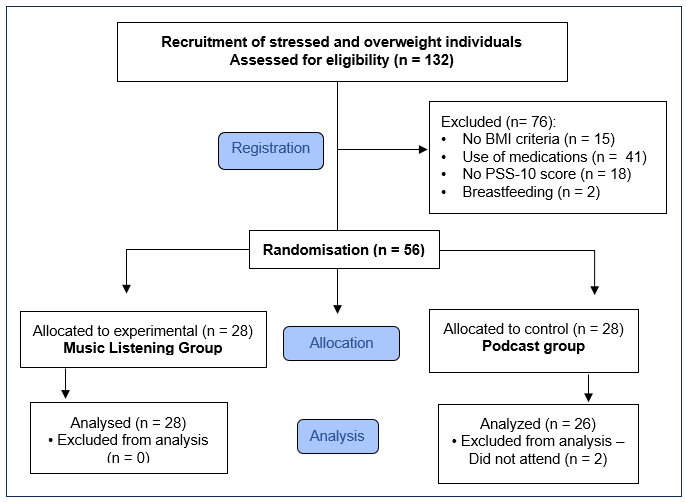
From a total of 132 screened individuals, 56 met the inclusion criteria and were randomized. The primary reasons for exclusion were BMI below the threshold, current medication use, and low stress scores (PSS-10 < 17). The participant flow, including allocation and analysis, is detailed in the CONSORT flowchart (Figure 1).
Figure 1 - Flowchart of participant allocation in the study, according to the CONSORT 2010 protocol
Source: Elaborated by the authors.
Baseline Characteristics
The clinical and epidemiological profiles of the participants are summarized in Table 2. A total of 54 participants completed the protocol (Experimental: n = 28; Control: n = 26). The sample was predominantly female (83.3%), with no significant differences between groups regarding age (p = 0.76), perceived stress scores (p = 0.83), or levels of emotional hunger (p = 0.40).
At baseline, groups were homogenous for most variables, including daily hydration (p = 0.86) and physical activity frequency (p = 0.50). Both cohorts exhibited a profile of high emotional hunger, low physical activity, and increased appetite. A single significant difference was observed in alcohol consumption, which was higher in the control group (p = 0.03). All participants confirmed access to the necessary mobile technology and headphones for the study procedures.
Table 2 - Descriptive profile of individuals in the experimental (n = 28) and control group (n = 26)
|
Sex |
Experimental (n = 28) |
Control (n = 26) |
p* value |
|
Man |
5 (17.9%) |
4 (15.4%) |
0.81 |
|
Woman |
23 (82.1%) |
22 (84.6%) |
|
|
Age |
37 (30 - 43) |
38 (29.5 - 43.5) |
0.76** |
|
Education |
|
|
|
|
Incomplete primary education |
0 (0%) |
1 (3.8%) |
0.51 |
|
Complete elementary education |
1 (3.7%) |
0 (0%) |
|
|
Incomplete High School Education |
1 (3.7%) |
1 (3.8%) |
|
|
Completed High School |
7 (25.9%) |
7 (26.9%) |
|
|
Incomplete Higher Education |
6 (22.2%) |
6 (23.1%) |
|
|
Completed Higher Education |
11 (40.8%) |
6 (23.1%) |
|
|
Postgraduate Studies |
1 (3.7%) |
4 (15.4%) |
|
|
Master's degree |
0 (0%) |
1 (3.8%) |
|
|
Marital status |
|
|
|
|
Married |
12 (44.4%) |
10 (41.7%) |
0.68 |
|
Divorced |
2 (7.4%) |
4 (16.6%) |
|
|
Single |
13 (48.2%) |
10 (41.7%) |
|
|
intestinal function |
|
|
|
|
Alternate |
5 (18.5%) |
6 (23.1%) |
0.76 |
|
Constipation |
6 (22.2%) |
6 (23.1%) |
|
|
Daily |
16 (59.3%) |
14 (53.8%) |
|
|
Appetite |
|
|
|
|
Increased |
16 (59.3%) |
12 (50%) |
0.61 |
|
Loss of appetite |
0 (0%) |
1 (4.2%) |
|
|
Normal |
11 (40.7%) |
11 (45.8%) |
|
|
Chew |
|
|
|
|
Suitable |
6 (23.1%) |
6 (25%) |
0.84 |
|
Compulsive |
1 (3.8%) |
0 (0%) |
|
|
Slow |
2 (7.7%) |
2 (8.3%) |
|
|
Normal |
0 (0%) |
1 (4.2%) |
|
|
Fast |
17 (65.4%) |
15 (62.5%) |
|
|
Smoking |
|
|
|
|
No |
25 (92.6%) |
22 (91.7%) |
0.80 |
|
Yes |
2 (7.4%) |
2 (8.3%) |
|
|
Alcoholic beverage |
|
|
|
|
No |
11 (40.7%) |
3 (11.5%) |
0.03 |
|
Yes |
16 (59.3%) |
23 (88.5%) |
|
|
pre -BMI |
|
|
|
|
Overweight |
9 (33.3%) |
8 (30.8%) |
0.46 |
|
Grade I Obesity |
14 (51.9%) |
10 (38.5%) |
|
|
Grade II Obesity |
4 (14.8%) |
7 (26.9%) |
|
|
Grade III Obesity |
0 (0%) |
1 (3.8%) |
Note: *Chi-square test; BMI = body mass index; Ob. = Obesity; SD = standard deviation. **Mann-Whitney test. Data are expressed as median (Q1 – Q3). Source: Elaborated by the authors.
Objective Measure (Salivary Cortisol)
Baseline cortisol levels did not differ
significantly between the experimental and control groups (p = 0.28),
confirming initial endocrine homogeneity. The Linear Mixed-Effects Model (LMM)
demonstrated high reliability (ICC = 0.615) and a robust fit ( = 0.663), revealing a
highly significant main effect of Time (F(1,52) = 37.45, p
< 0.001). Although no significant differences were observed between groups
post-intervention (p = 0.89), intragroup analysis using Bonferroni
correction revealed distinct physiological responses between cohorts.
= 0.663), revealing a
highly significant main effect of Time (F(1,52) = 37.45, p
< 0.001). Although no significant differences were observed between groups
post-intervention (p = 0.89), intragroup analysis using Bonferroni
correction revealed distinct physiological responses between cohorts.
Following adjustment for multiple
comparisons, the experimental group maintained a highly significant reduction
in median salivary cortisol, decreasing from 7.48 (5.54–10.39) nmol/L to 4.15
(3.53–6.16) nmol/L (padj < 0.001), with a large effect
size ( ). In contrast, the
reduction in the control group – from 5.81 (4.43–10.73) nmol/L to 4.15
(3.12–6.09) nmol/L – did not reach statistical significance after
adjustment (padj = 0.07), exhibiting only a moderate effect
size (r = 0.37). Despite the non-significant group-time interaction (F(1,52)
= 1.67, p = 0.20), these data indicate that music listening provided a more
robust and statistically reliable neuroendocrine stabilization than the control
condition (Table 3). Importantly, this interaction result was cross-validated
using permutation-based ANOVA (pperm = 0.20), confirming that the
observed findings are independent of data distribution assumptions and remain
consistent even under non-parametric resampling.
). In contrast, the
reduction in the control group – from 5.81 (4.43–10.73) nmol/L to 4.15
(3.12–6.09) nmol/L – did not reach statistical significance after
adjustment (padj = 0.07), exhibiting only a moderate effect
size (r = 0.37). Despite the non-significant group-time interaction (F(1,52)
= 1.67, p = 0.20), these data indicate that music listening provided a more
robust and statistically reliable neuroendocrine stabilization than the control
condition (Table 3). Importantly, this interaction result was cross-validated
using permutation-based ANOVA (pperm = 0.20), confirming that the
observed findings are independent of data distribution assumptions and remain
consistent even under non-parametric resampling.
Table 3 - Pre- and post-test salivary cortisol levels between experimental (n = 28) and control groups (n = 26)
|
Variable |
Experimental (n = 28) |
Control (n = 26) |
p-value (between)¹ |
|
Pre-intervention |
7.48 (5.54 – 10.39) |
5.81 (4.43 – 10.73) |
0.28 |
|
Post-intervention |
4.15 (3.53 – 6.16) |
4.15 (3.12 – 6.09) |
0.89 |
|
Change Significance (p)² |
< 0.01 |
0.07 |
-- |
|
Effect Size (r) [95% CI] |
0.85 [0.68, 0.87] |
0.42 [0.02, 0.68] |
-- |
|
LMM Interaction (p)³ |
-- |
-- |
0.20 |
Note: Data
are expressed as Median (Q1 – Q3). ¹Mann-Whitney U test for intergroup
comparison. ²Wilcoxon signed-rank test for intragroup comparison. ³Linear
Mixed-Effects Model (LMM) interaction (Group:Time). LMM Performance:  = 0.663;
  = 0.125; ICC = 0.615; Main
Effect of Time: F(1,52) = 37.45, p < 0.001.
= 0.125; ICC = 0.615; Main
Effect of Time: F(1,52) = 37.45, p < 0.001.
Individual Trajectories and Responder Analysis
Individual cortisol trajectories (Figure 2) revealed that 92.9% (n=26) of the experimental group participants exhibited a reduction in cortisol levels, compared to 80.8% (n=21) in the control group. Fisher’s Exact Test indicated that participants in the music group had a three-fold higher chance of reducing cortisol (Odds Ratio = 3.03; 95% CI [0.44, 34.90]) compared to the control group. Furthermore, the clinical failure rate (cortisol increase post-intervention) was substantially lower in the experimental group (3.6%) than in the control group (19.2%). These data suggest that listening to music acts as a more consistent and low-risk biological brake on the HPA axis, compared with listening to podcasts, in overweight individuals.
Figure 2 - Individual and Group Cortisol Trajectories
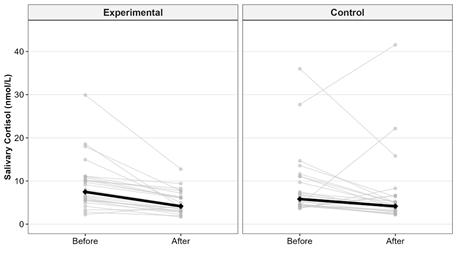
Note: Thin gray lines represent individual participants; bold black lines represent group medians. nmol/L = nanomoles per liter. Source: Elaborated by the authors.
Subjective Stress and Relaxation Markers
The psychological impact was assessed through a multi-item VAS, with p-values adjusted via Bonferroni correction to ensure maximum statistical stringency (Table 4). The music intervention induced a robust psychophysiological shift, characterized by a significant increase in both “Relaxed Body” (padj = 0.035, r = 0.51) and “Relaxed Mind” (padj < 0.001, g = 0.73). No other variables in the experimental group reached significance after adjustment.
In stark contrast, the control group failed to produce any statistically significant changes across all subjective markers after Bonferroni correction. Although a marginal reduction in “Agitated Mind” was observed (padj = 0.07), it did not meet the threshold for reliability. These findings indicate that the musical stimulus possesses a unique capacity to acutely modulate the subjective state of individuals with overweight, moving them into a verified state of relaxation that narrative stimuli cannot replicate.
Table 4 - Hypothesis Tests of Subjective Variables Before and After the Intervention
|
MTC pre; post |
Statistic |
P |
Effect Size |
Confidence Interval |
|
||||||
|
5; 7 |
V = 70 |
0.03 |
r = 0.51 |
[0.17; 0.76] |
|
||||||
|
5; 3 |
V = 229 |
0.12 |
r = 0.42 |
[0.04; 0.67] |
|
||||||
|
Agitated Mind |
5.21; 3.71 |
t = 1.96 |
0.21 |
D = 0.52 |
[-0.01; 1.04] |
|
|||||
|
4.54; 6.36 |
t = -2.76 |
< 0.01 |
D = -0.73 |
[-1.26; -0.19] |
|
||||||
|
Irritability |
1.5; 1.5 |
V = 131 |
0.79 |
r = 0.29 |
[0.01; 0.6] |
|
|||||
|
Control Group |
|
||||||||||
|
Variable |
MTC pre; post |
Statistic |
P |
Effect Size |
Confidence Interval |
|
|||||
|
Relaxed Body |
6; 5.5 |
V = 54 |
0.85 |
r = 0.28 |
[0.01; 0.58] |
|
|||||
|
Tense Body |
6,00; 4.96 |
t = 2.01 |
0.29 |
D= 0.38 |
[-0.01; 0.77] |
|
|||||
|
7.5; 5.5 |
V = 156 |
0.07 |
r = 0.43 |
[0.07; 0.69] |
|
||||||
|
Relaxed Mind |
5.42; 6.08 |
t = -0.94 |
0.35 |
D = -0.26 |
[-0.79; 0.28] |
|
|||||
|
Irritability |
3; 2.5 |
V = 380.5 |
0.43 |
r = 0.43 |
[0.06; 0.69] |
|
|||||
Note: All p-values were adjusted using the Bonferroni method for 5 simultaneous comparisons per group. Bold values indicate significance at p < 0.05. MTC = central tendency measure means for parametric tests, medians for non-parametric tests; p = statistical significance; t = Student’s t-test statistic; V = Wilcoxon test statistic. Significant values are bold. Source: Elaborated by the authors.
Notably, a significant positive correlation was found between the improvements in Relaxed Body and Relaxed Mind within the experimental group (r = 0.73, pperm < 0.001, CI95% [0.4514, 0.9116]), a coupling that was not observed in the control group. This strong psychophysiological coupling suggests that the music-based intervention induced a synchronized state of relaxation, where subjective mental tranquility directly paralleled the perceived reduction in physical tension, a synergy that was absent in the control condition.
Qualitative Analysis: Topic Modeling and Testimonials
The unsupervised topic modeling revealed two distinct experiential profiles, reflecting the different natures of the auditory stimuli.
Music Experience
In the experimental group, the linguistic clusters formed a semantic field predominantly centered on Emotional Response to Music and the immediate modulation of Emotions and Feelings. The music-based intervention appeared to bypass purely cognitive processing, triggering a sense of Well-Being and Daily Life improvement that was deeply embodied. This is evidenced by the high probability of keywords associated with "peace" and "possibility."
The participants’ testimonies underpin these statistical groupings with lived experience, describing the intervention as a catalyst for hope: Participant 01: “Music brings a sense of peace... bringing a sense of possibility – it is possible to achieve what one dreams of”; Participant 02: “I feel really good. With a very calm spirit, more relaxed. I wish we could have this moment in our daily lives, preferably at the start of the day.”
This “mixture of sensations” suggests that the music group experienced a marked change in their existential state, moving from the tension reported at the start of the study to a feeling of being “light and at peace with life”. The influence of environmental factors (Impact of External Sounds) emerged as a secondary, albeit present, layer of the experience, without disrupting the central emotional shift (Figure 3).
Figure 3 - Words per topic in the experimental group
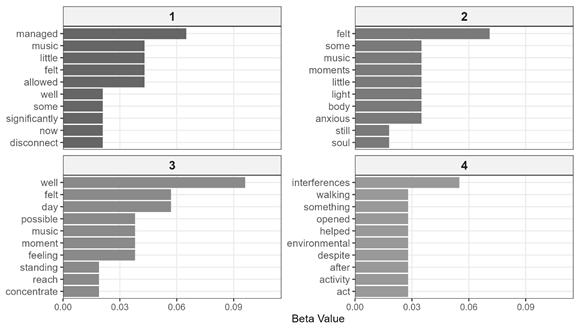
Note: Beta = Linguistic clusters (Topics 1 to 4) for the experimental group. Higher Beta values indicate stronger relevance of the word to the specific topic.
Source: Elaborated by the authors.
Control Experience
Conversely, the control group’s experience was characterized by a more intellectualized and reflective process. The topics Emotions and Personal Experiences and Reflections on Life suggest that the podcast acted as a mirror for the participants' own histories. Rather than a direct sensory shift, the relaxation in this group was mediated by Social Interaction and Normality, where identifying with the "other" in the story facilitated a state of Well-Being and Calmness.
The narrative nature of the prompt led to conscious reflections on self-care: Participant 1: “I realised I need to set aside some time for myself... By taking a break during this period, I was able to reflect.” Whilst the music group felt a sense of peace, the control group understood the need for it through empathy: Participant 2: “The story makes us realise that, although the world is so chaotic, there are still people who care about others.”
Figure 4 - Words per topic in the control group
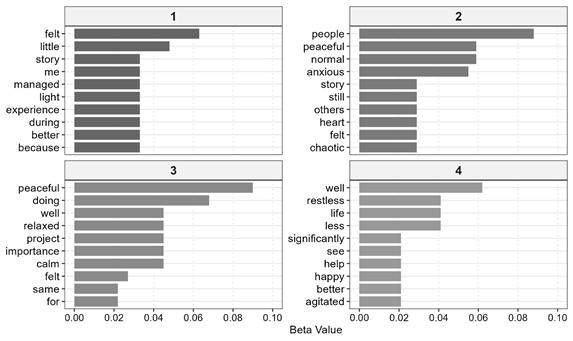
Note: Beta = Linguistic clusters (Topics 1 to 4) for the control group. Higher Beta values indicate stronger relevance of the word to the specific topic.
Source: Elaborated by the authors.
Comparison between music and control trials
Thus, the qualitative data suggest that, although both interventions provided a “pause”, the music triggered an affective-sensory response, whilst the podcast promoted cognitive-empathic reflection (Figure 4). The qualitative results confirm and extend the quantitative findings. While the cortisol and VAS data demonstrated physiological and subjective relaxation, topic modeling revealed the nature of this shift: an affective-sensory immersion for the music group versus a cognitive-empathetic reflection for the control group.
DISCUSSION
Neuroendocrine Stabilization: The Power of Musical Structure
The initial reduction in salivary cortisol observed in both groups raises a fundamental question: is the benefit derived from the specific auditory stimulus or simply from the “pause” itself? While a quiet, reflective pause (the podcast control) may induce mild parasympathetic activation, our results under the stringent Bonferroni correction clarify this distinction. Following adjustment, the reduction in the control group lost statistical significance (padj = 0.07, r = 0.37), whereas the music intervention maintained a highly significant and large effect (padj < 0.001, r = 0.59).
This finding aligns with Khalfa et al. (2003), who demonstrated that music stabilizes cortisol where neutral stimuli fail. Interestingly, while 92.9% of the music group showed a cortisol decrease, in a three-fold higher chance of success for the music group (OR = 3.03). This suggests that for individuals with overweight, who often face a chronically elevated HPA axis, music provides a robust and “safe” biological braking system, whereas cognitive-narrative tasks may yield unpredictable hormonal responses.
Psychosomatic Coupling
The music group was the only one to show significant improvements in core relaxation dimensions of Relaxed Body and Relaxed Mind. This focused effectiveness is consistent with Lee et al. (2016) and Linnemann et al. (2016), who noted that music utilized for relaxation yields superior subjective outcomes.
A pivotal finding of this study was the strong positive correlation (r = 0.73, p < 0.001) between the improvements in physical and mental relaxation within the music group. This psychosomatic coupling explains 55% of the shared variance between body and mind, suggesting that the music-based intervention triggered a synchronized state of tranquility. This synergy was absent in the control group, indicating that music possesses a unique capacity to integrate physiological and psychological states – a mechanism likely responsible for the superior cortisol reduction observed. Our results contrast with Thoma et al. (2013), potentially because individuals with overweight carry a higher "psychological load," making them more responsive to the affective-sensory immersion of music.
While our findings align with the trends observed by Khalfa et al. (2003) and Linnemann et al. (2015), this study provides more robust evidence through a randomized controlled design. Furthermore, unlike Thoma et al. (2013), who utilized a specific classical piece (Miserere), our intervention employed culturally familiar genres (e.g., Sertanejo). From a Psychoneuroendocrinological perspective, this cultural familiarity may have reduced the cognitive load and enhanced the affective-sensory immersion, leading to the superior cortisol stabilization observed in our experimental group.
Qualitative Synergy and Existential Resilience
Topic modeling revealed that music reached desired psychological states, such as motivation and existential peace, which were absent in the control group’s cognitive themes. The combination of structural musical properties (Thaut, 2003) and reflective lyrics likely accounts for the superior biological response. While the control group derived benefit from narrative empathy, the music group experienced an acute shift in their existential state, acting as a bridge to emotional resilience that purely narrative stimuli could not replicate.
Limitations and Future Directions
This study employed a single session; while the acute effects are compelling, the long-term sustainability of music medicine in obesity treatment requires longitudinal research. The use of a personalized music-based interventions, supported by Raglio et al. (2020) for physiological consistency, may not capture the full potential of individualized music medicine. Finally, although a baseline difference in alcohol consumption was noted, the cohorts remained homogenous regarding perceived stress and baseline cortisol, ensuring the internal validity of the comparisons. Furthermore, the inability to adopt a double-blind design may be considered a methodological limitation of the study.
CONCLUSION
By triangulating Linear Mixed-Effects Models, psychosomatic correlation analysis, and qualitative reports, this study demonstrates that music is a superior and more predictable tool for neuroendocrine stabilization in overweight individuals compared to narrative stimuli. The robust finding that music listening yielded a large effect size and a 93% responder rate, while the control group failed to maintain significance after Bonferroni adjustment, highlights its unique therapeutic value.
Music listening represents a low-cost, non-pharmacological, and highly scalable intervention with no reported side effects. In the context of the global obesity crisis (World Health Organization, 2023), it serves as a viable adjunctive resource to disrupt the deleterious feedback loop between stress-induced cortisol and hyperphagia. This research provides a basis for future longitudinal studies investigating whether music-based interventions can induce a permanent remodelling of the HPA axis, ultimately increasing the biological and emotional resilience of individuals living with excess weight.
REFERENCES
Adiasto, K., Beckers, D. G. J., van Hooff, M. L. M., Roelofs, K., & Geurts, S. A. E. (2022). Music listening and stress recovery in healthy individuals: A systematic review with meta-analysis of experimental studies. PLOS ONE, 17(6), e0270031. https://doi.org/10.1371/journal.pone.0270031
Barbaresi, M., Nardo, D., & Fagioli, S. (2025). Physiological Entrainment: A Key Mind–Body Mechanism for Cognitive, Motor and Affective Functioning, and Well-Being. Brain Sciences, 15(1), 3. https://doi.org/10.3390/brainsci15010003
Beck, B. D., Hansen, Å. M., & Gold, C. (2015). Coping with work-related stress through Guided Imagery and Music (GIM): Randomized controlled trial. Journal of Music Therapy, 52(3), 323–352.
Calamassi, D., Vigni, M. L. L., Fumagalli, C., Gheri, F., Pomponi, G. P., & Bambi, S. (2022). The Listening to music tuned to 440 Hz versus 432 Hz to reduce anxiety and stress in emergency nurses during the COVID-19 pandemic: a double-blind, randomized controlled pilot study: Listening to music to 440 Hz versus 432 Hz in emergency nurses. Acta Biomedica Atenei Parmensis, 93(S2), e2022149–e2022149. https://doi.org/10.23750/abm.v93iS2.12915
Carvalho, I. P., Ribeiro, A., Pedrosa, F. G., & Drummond, J. B. (2024, December 2). Efeitos da escuta musical sobre a redução do estresse de indivíduos em tratamento nutricional para excesso de peso. Universidade Federal de Minas Gerais.https://repositorio.ufmg.br/items/fc63d521-e22b-4f48-87bf-a39d73d8ab-2e/full
Czepczor-Bernat, K., Modrzejewska, A., Modrzejewska, J., & Majzner, R. (2021). Comparison of Food-Based and Music-Based Regulatory Strategies for (Un)Healthy Eating, Depression, Anxiety and Stress. Nutrients, 14(1), 187. https://doi.org/10.3390/nu14010187
Dallman, M. F. (2010). Stress-induced obesity and the emotional nervous system. Trends in Endocrinology & Metabolism, 21(3), 159–165. https://doi.org/10.1016/j.tem.2009.10.004
Dib, S., Wells, J. C. K., & Fewtrell, M. (2020). A within-subject comparison of different relaxation therapies in eliciting physiological and psychological changes in young women. PeerJ, 8, e9217. https://doi.org/10.7717/peerj.9217
Dorsey, A., Scherer, E. M., Eckhoff, R., & Furberg, R. (2022). Measurement of Human Stress: A Multidimensional Approach. RTI Press. https://doi.org/-10.3768/rtipress.2022.op.0073.2206
Gouveia, V. V., Pimentel, C. E., Santana, Chaves, W. A., & Rodrigues, C. A. (2017). Escala abreviada de preferência musical (STOMP): evidências de sua validade fatorial e consistência interna. Psico, 39(2). https://revistaseletronicas.pucrs.-br/revistapsico/article/view/1497
Gupta, V., & Lehal, G. (2009). A survey of text mining techniques and applications. Journal of Emerging Technologies in Web Intelligence, 1(1), 60–76. https://doi.org/10.4304/jetwi.1.1.60-76
Hopewell, S., Chan, A.-W., Collins, G. S., Hróbjartsson, A., Moher, D., Schulz, K. F., Tunn, R., Aggarwal, R., Berkwits, M., Berlin, J. A., Bhandari, N., Butcher, N. J., Campbell, M. K., Chidebe, R. C. W., Elbourne, D., Farmer, A., Fergusson, D. A., Golub, R. M., Goodman, S. N., & Hoffmann, T. C. (2025). CONSORT 2025 statement: updated guideline for reporting randomised trials. BMJ, 389, e081123. https://doi.org/10.1136/bmj-2024-081123
Khalfa, s., Bella, S. D., Roy, M., Peretz, I., & Lupien, S. J. (2003). Effects of Relaxing Music on Salivary Cortisol Level after Psychological Stress. Annals of the New York Academy of Sciences, 999(1), 374–376. https://doi.org/10.1196/annals.-1284.045
Kunikullaya Ubrangala, K., Kunnavil, R., Sanjeeva Vernekar, M., Goturu, J., Vijayadas, Prakash, V. S., & Murthy, N. S. (2022). Effect of Indian Music as an Auditory Stimulus on Physiological Measures of Stress, Anxiety, Cardiovascular and Autonomic Responses in Humans—A Randomized Controlled Trial. European Journal of Investigation in Health, Psychology and Education, 12(10), 1535–1558. https://doi.org/10.3390/ejihpe12100108
Kyrou, I., Chrousos, G. P., & Tsigos, C. (2006). Stress, visceral obesity, and metabolic complications. Annals of the New York Academy of Sciences, 1083(1), 77–110. https://doi.org/10.1196/annals.1367.008
Lee, K. S., Jeong, H. C., Yim, J. E., & Jeon, M. Y. (2016). Effects of Music Therapy on the Cardiovascular and Autonomic Nervous System in Stress-Induced University Students: A Randomized Controlled Trial. The Journal of Alternative and Complementary Medicine, 22(1), 59–65. https://doi.org/10.1089/acm.201-5.0079
Lee-Harris, G., Timmers, R., Humberstone, N., & Blackburn, D. (2018). Music for Relaxation: A Comparison Across Two Age Groups. Journal of Music Therapy, 55(4), 439–462. https://doi.org/10.1093/jmt/thy016
Linnemann, A., Ditzen, B., Strahler, J., Doerr, J. M., & Nater, U. M. (2015). Music listening as a means of stress reduction in daily life. Psychoneuroendocrinology, 60(60), 82–90. https://doi.org/10.1016/j.psyneuen.2015.06.008
Linnemann, A., Strahler, J., & Nater, U. M. (2016). The stress-reducing effect of music listening varies depending on the social context. Psychoneuroendo-crinology, 72, 97–105. https://doi.org/10.1016/j.psyneuen.2016.06.003
Lizama, A. J. C., Villanueva, B. J., Martínez, D. P., Leiva, F. C., & Mella, E. R. (2020). Obesity: Perceived Self-Efficacy, Emotional Regulation and Stress. Psicologia: Teoria e Pesquisa, 36. https://doi.org/10.1590/0102.3772e36411
Mardia, K. V. (1970). Measures of multivariate skewness and kurtosis with applications. Biometrika, 57(3), 519–530. https://doi.org/10.2307/2334770
Medeiros Neto, C. F. de, Almeida, G. A. de, Ramos, B. da C., Costa, S. K. P. da, Silva, H. P. A. da, & Sousa, M. B. C. de. (2012). Análise da percepção da fadiga, estresse e ansiedade em trabalhadores de uma indústria de calçados. Jornal Brasileiro de Psiquiatria, 61(3), 133–138. https://doi.org/10.1590/s0047-20852012000300003
Nikita, M. (2024). ldatuning (Version 1.0.3) [R package]. https://github.com/nikita-moor/ldatuning
Ovbiosa-Akinbosoye, O. E., & Long, D. A. (2011). Factors associated with long-term weight loss and weight maintenance. Journal of Occupational and Environmental Medicine, 53(11), 1236–1242. https://doi.org/10.1097/jom.0b-013e31823401db
Pastore, C. M. A., & Francisco-Maffezzolli, E. C. (2018). O uso de cortisol salivar como marcador biológico para o stress em pesquisas de comportamento do consumidor. Revista Brasileira de Marketing, 17(3), 385–400. https://doi.org/1-0.5585/remark.v17i3.3700
Pedrosa, F., Veiga Loureiro, C. M., & Duarte Garcia, F. (2022). Musicoterapia na dependência química: Uma revisão integrativa. Música Hodie, 22. https://doi.org/10.5216/mh.v22.70651
Pedrosa, F. G., & Reis, J. (2023). Análises quantitativas de dados qualitativos: Uso de técnicas de mineração de textos para a clínica musicoterapêutica. Revista InCantare, 16(1), 54–70. https://doi.org/10.33871/2317417X.2022.16.1.8293
Pimentel, C. E., Gouveia, V. V., & Pessoa, V. S. (2007). Escala de Preferência Musical: construção e comprovação da sua estrutura fatorial. Psico-USF, 12(2), 145–155. https://doi.org/10.1590/s1413-82712007000200003
Radstaak, M., Geurts, S. A. E., Brosschot, J. F., & Kompier, M. A. J. (2014). Music and Psychophysiological Recovery from Stress. Psychosomatic Medicine, 76(7), 529–537. https://doi.org/10.1097/psy.0000000000000094
Luft, C. D. B., Sanches, S. de O., Mazo, G. Z., & Andrade, A. (2007). Versão brasileira da Escala de Estresse Percebido: tradução e validação para idosos. Revista de Saúde Pública, 41, 606–615. https://doi.org/10.1590/S0034-891020070004-00015
Roche Diagnostics. (2021). Imunoensaio para determinação quantitativa in vitro do cortisol em soro, plasma e saliva humanos: Elecsys Cortisol II. COBAS e402/801. Roche.
Schulz, K., Altman, D., & Moher, D. (2010). CONSORT 2010 statement: Updated guidelines for reporting parallel group randomised trials. Journal of Pharmacology and Pharmacotherapeutics, 1(2), 100. https://doi.org/10.410-3/0976-500x.72352
Silverman, M. J. (2015). Effects of lyric analysis interventions on treatment motivation in patients on a detoxification unit: A randomized effectiveness study. Journal of Music Therapy, 52(1), 117–134. https://doi.org/10.1093/jmt/thu057
Stubbs, R. J., Hughes, D. A., Johnstone, A. M., Rowley, E., Reid, C., Elia, M., Stratton, R., Delargy, H., King, N., & Blundell, J. E. (2000). The use of visual analogue scales to assess motivation to eat in human subjects: a review of their reliability and validity with an evaluation of new hand-held computerized systems for temporal tracking of appetite ratings. British Journal of Nutrition, 84(4), 405–415. https://doi.org/10.1017/s0007114500001719
Taets, G. G. D. C., Borba-Pinheiro, C. J., Figueiredo, N. M. A. de, & Dantas, E. H. M. (2013). Impacto de um programa de musicoterapia sobre o nível de estresse de profissionais de saúde. Revista Brasileira de Enfermagem, 66, 385–390. https://doi.org/10.1590/S0034-71672013000300013
Thaut, M. H. (2003). Neural basis of rhythmic timing networks in the human brain. Annals of the New York Academy of Sciences, 999(1), 364–373. https://doi.org/10.1196/annals.1284.044
Thoma, M. V., La Marca, R., Brönnimann, R., Finkel, L., Ehlert, U., & Nater, U. M. (2013). The effect of music on the human stress response. PLoS ONE, 8(8), e70156. https://doi.org/10.1371/journal.pone.0070156
Tsigos, C., & Chrousos, G. P. (2002). Hypothalamic–pituitary–adrenal axis, neuroendocrine factors and stress. Journal of Psychosomatic Research, 53(4), 865–871. https://doi.org/10.1016/s0022-3999(02)00429-4
Van Rossum, E. F. C. (2017). Obesity and cortisol: New perspectives on an old theme. Obesity, 25(3), 500–501. https://doi.org/10.1002/oby.21774
Witusik, A., Kaczmarek, S., Kosmalski, M., & Pietras, T. (2023). The role of music therapy in the treatment of obesity and metabolic syndrome – psychological and medical context. Polski Merkuriusz Lekarski, 51(1), 59–63. https://doi.org/-10.36740/merkur202301109
Witte, M., Spruit, A., van Hooren, S., Moonen, X., & Stams, G.-J. (2020). Effects of music interventions on stress-related outcomes: a systematic review and two meta-analyses. Health Psychology Review, 14(2), 294–324. https://doi.org/-10.1080/17437199.2019.1627897
World Health Organization. (1995). Physical status: the use and interpretation of anthropometry. Geneva: Wold Health Organization; 1995. WHO technical report series 854.
World Health Organization. (2023). WHO acceleration plan to stop obesity. https://-www.who.int/publications/i/item/9789240075634
World Health Organization, & Unicef. (2026). The WHO acceleration plan to stop obesity: A joint WHO/UNICEF operational model for designing and implementing the response. https://www.who.int/publications/i/item/9789240116054
Wong, M. M., Tahir, T., Wong, M. M., Baron, A., & Finnerty, R. (2021). Biomarkers of stress in music interventions: A systematic review. Journal of Music The-rapy, 58(3). https://doi.org/10.1093/jmt/thab003
Accepted: 06/24/2026